US and UK · inches and centimetres / Decision guide
Will a 2000-piece puzzle fit your board? Check both dimensions
Compare the exact finished puzzle dimensions with the board’s unobstructed working rectangle, in both orientations. A 38.6 by 29.5 inch puzzle does not fit a 40 by 28 inch surface either way, even if the board is described as suitable for 2000 pieces.
For US and UK puzzlers checking a board they own or plan to buy. The examples are dimensional arithmetic, not physical board tests or product recommendations.
Find the two measurements that matter
Start with the finished size on your exact puzzle box or its product specification. Piece count is a shortcut, not a dimension. Ravensburger’s size guide gives a typical 2000-piece example of 38.6 by 29.5 inches and a 1000-piece panorama example of 38.5 by 14.8 inches. Other puzzles and editions can differ.
For the board, find the continuous flat area available for assembly. Measure between raised borders or other obstructions. Exterior dimensions, separate drawers and a storage compartment do not establish that rectangle. If the usable width and depth are missing, ask the seller for them before ordering.
Check both orientations, not just the longest side
On small screens, scroll the table sideways.
| Puzzle on a 40 × 28 inch working area | Width check | Depth check | Result |
|---|---|---|---|
| 38.6 × 29.5 inches | 38.6 ≤ 40 | 29.5 > 28 | Fails depth |
| Turned 90°: 29.5 × 38.6 inches | 29.5 ≤ 40 | 38.6 > 28 | Fails depth |
| Panorama: 38.5 × 14.8 inches | 38.5 ≤ 40 | 14.8 ≤ 28 | Passes the rectangle check |
Scroll the diagram sideways to read all labels.
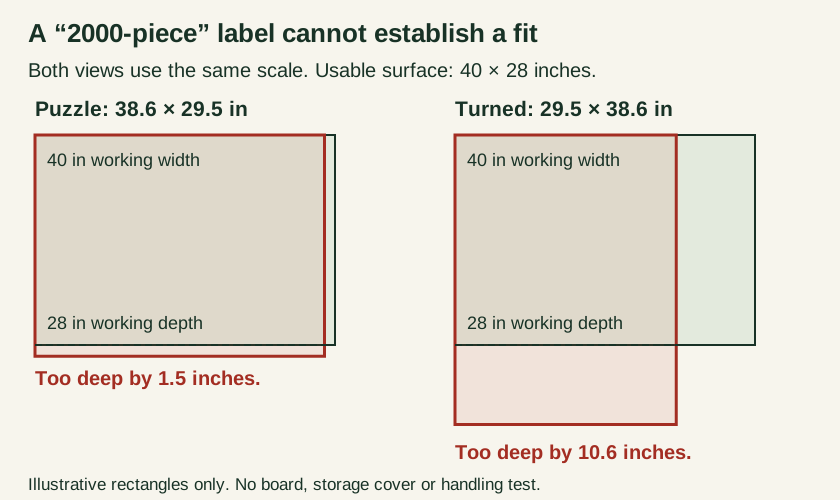
The panorama passes only the stated two-dimensional check; it does not prove the board is comfortable to use, stable, or suitable for storage. A smaller piece count can still have almost the same long dimension.
Use one unit throughout
One inch is exactly 2.54 centimetres. The examples convert to 98.044 × 74.93 cm for the 2000-piece puzzle, 101.6 × 71.12 cm for the illustrative board, and 97.79 × 37.592 cm for the panorama. Compare unrounded measurements where possible; rounding a displayed dimension cannot create missing space.
For a puzzle sized P × Q and a working rectangle W × D, the straight-edge checks are P ≤ W and Q ≤ D, or Q ≤ W and P ≤ D. This guide assesses those two orthogonal orientations; it does not treat diagonal placement or overhanging pieces as a successful fit.
Plan sorting and storage separately
After the assembled rectangle passes, decide where loose pieces and sorting trays will go. Measure the actual cover opening and storage location; if you plan to rotate the board, check clearance around it too. A rectangle match does not establish lid clearance, portability or safe movement.
An exact edge-to-edge match also leaves no allowance for measurement uncertainty or access around the pieces. Check your actual setup rather than adding an invented universal handling margin. If either measurement is uncertain, resolve it before buying.