US examples · cat-care measurements / Decision guide
Choose a low entry high sided litter box by measuring the right places
For a cat that needs easy access but urinates over an edge, check the entrance threshold, usable interior floor and remaining wall heights separately. “Low entry” and “high sided” do not tell you whether a particular box fits your cat, and tall walls cannot contain urine directed through an open doorway.
First, address any new or repeated change in toileting with your veterinarian. If your cat is straining and passing little or no urine, seek immediate veterinary care rather than trying a different box. A urinary blockage can be life-threatening, as Cornell’s Feline Health Center explains.
This guide helps you compare physical fit. It is not a diagnosis, arthritis treatment or promise to stop accidents, and the product examples below have not been tested by Everyday Sift.
Find where the urine is escaping
Observe without interrupting or crowding your cat. Record the wet area and, when you can see it, the route the urine takes. A puddle beside the box does not identify the cause by itself.
- Over a side or back wall: wall height and the cat’s position are relevant measurements.
- Through the entrance: raising the other walls does not close that opening.
- At a removable rim or hood seam: examine the joint and how the upper and lower sections overlap. Overall height alone cannot establish containment.
- Outside without entering: treat this as a broader litter-box or health problem, not proof that taller sides are needed.
Cornell’s house-soiling guidance describes medical, litter, box and location factors. A change in where a cat urinates deserves investigation even if the cat otherwise seems well.
Measure the entry threshold from the floor
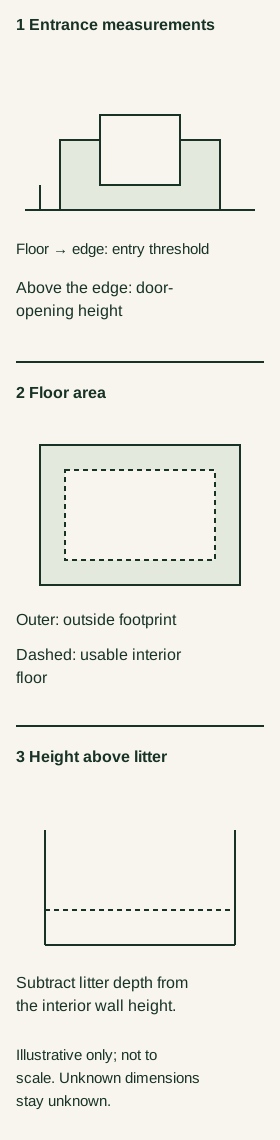
The threshold is the height the cat must step over from the room floor, or from the actual stable approach surface. Measure to the top of the lowest usable entrance edge. Also record the opening’s clear width and any projecting lip.
Door opening height is a different measurement: it describes the space above the threshold. A doorway can be tall while still requiring a substantial step up. A product’s overall height does not reveal either one.
Use the cat’s current comfortable access and your veterinarian’s advice to set requirements, rather than choosing a universal “senior cat” height. The Feline Veterinary Medical Association’s senior-care guidance identifies a lower-entry box as one possible adjustment for easier access.
Do not assume adding more litter solves a high entrance. It does not lower the step from the room floor and can reduce the wall height above the litter inside.
Scroll the diagram sideways to read all labels.
Measure the floor where the cat stands
Check the clear interior length and width near the bottom of the pan, not just the outside rim. Tapered walls, curved corners and an entrance recess can reduce the usable area. Ask the seller where its measurements were taken.
Compare these measurements with the box your cat already uses and observe whether the cat can enter, turn and position themselves without being cramped. A larger outside dimension is not evidence of a larger usable floor. A cover can further limit standing and turning space, so check internal headroom if considering one.
For a box already in your home, empty and clean it before measuring the bottom. Record the floor dimensions and the space at the usual litter level separately if the shape changes substantially. For an online purchase, leave a missing measurement marked unknown rather than estimating it from a photograph.
Measure the walls and inspect every joint
Record the height of the back and both sides from the interior pan floor. Then note the height remaining above your normal litter level. Those measurements answer a different question from the outside height used to check whether the box fits under a shelf.
Look at where a removable rim or hood meets the base. Ask whether the overlap directs liquid back inside, where the seam sits, and whether the maker provides cleaning and assembly instructions. A manufacturer’s anti-leak claim is not proof that the box will contain your cat’s particular aim.
An external splash shield may protect a nearby surface, but it does not change the box’s entrance height or usable floor. If you use one, keep the approach open and the arrangement stable and cleanable. Avoid creating a narrow passage to reach the doorway.
Read product measurements without filling in the gaps
These US-market examples illustrate what a specification does and does not establish. They are not a ranked shortlist.
KittyGoHere Senior Cat Litter Box Large: the manufacturer’s product page states a 3-inch (7.6 cm) entrance. That is a useful access measurement. It does not, by itself, verify the clear interior floor or establish that the other walls are tall enough for your cat. Confirm those separately.
Arm & Hammer Large Rimmed Wave: Petmate describes a low front, but the inspected listing does not provide a numerical threshold. Its overall dimensions cannot supply that missing measurement. “Low” remains a description until the height is confirmed.
Catit Airsift Regular and Jumbo: Catit lists a door opening 10.4 inches high by 9.6 inches wide, approximately 26.4 by 24.4 cm. Those numbers describe the opening, not the step-over threshold. The page also describes an overlap mechanism and raised back; these are manufacturer design claims, not an independent leak test.
If a seller cannot provide the measurements that matter, do not replace them with estimates or a “best for seniors” label.
Make the change without adding another obstacle
Keep the route to the box straightforward. Cornell advises accessible locations and avoiding stairs when the cat has difficulty using them. Do not hide an accessible box behind furniture that makes getting to it difficult.
A hood is not automatically an improvement. Cornell notes that many cats prefer uncovered boxes; individual acceptance still matters. Check both physical clearance and your cat’s willingness to enter rather than assuming that enclosing the box solves the problem.
Before purchase, record six things: entrance height and width, clear interior floor, remaining wall heights, seam design, outside footprint and the space needed to approach. Check the seller’s return conditions before putting litter in a new box. Do not cut down a box or leave improvised sharp edges as a shortcut to the required measurements.
Choose only after the important dimensions are known. If easy entry, sufficient turning space and containment cannot all be met by one candidate, keep looking or discuss an arrangement with your veterinarian. Preserving comfortable access matters more than finding the tallest walls.