UK and Europe · uninsulated shells / Decision guide
How to reproof a rain shell without a tumble dryer
You can reproof some uninsulated rain shells without a tumble dryer, but you need two compatible sets of instructions: the jacket's care label and the exact treatment's label. An air-drying treatment can remove the need for heat activation. It does not override a garment restriction or repair damaged waterproof fabric.
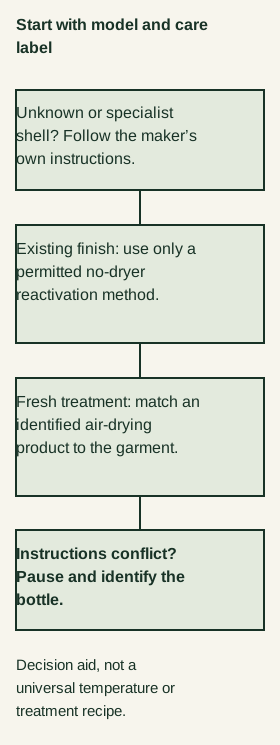
Choose between three routes:
- Restore the existing finish after cleaning, using only a method the garment maker permits.
- Apply an identified treatment that expressly allows air-drying and suits the jacket.
- Pause if the bottle, product page and garment instructions conflict. Resolve the product identity before applying it.
This is a documentation-based guide to uninsulated rain shells, not down jackets, padded coats or a ranking of tested reproofers. Garments with specialist exposed membranes, including GORE-TEX SHAKEDRY, need their own care instructions.
Scroll the diagram sideways to read all labels.
Work out which problem you are treating
Durable water repellency, usually shortened to DWR, helps water bead on the outer surface. When that surface darkens and soaks up rain, the jacket may be wetting out. Dirt can interfere with repellency, so cleaning may be enough before another treatment is needed. Nikwax cleaning and reproofing guidance
Inspect the jacket before washing. Note holes, lifting seam tape, peeling layers or a repeatable patch of leakage. Ask the garment maker about those faults rather than assuming another dose of proofer will solve them. A damp feeling inside also deserves a closer look at when it happens; it is not a reliable diagnosis by itself.
The practical distinction is between maintaining the surface finish and repairing the garment. Beading is useful to observe, but a successful bead check is not a waterproofness test of seams, zips and the whole fabric system.
Read the jacket label before choosing a product
Find the model name as well as the washing, drying and ironing symbols. Look up the maker's care instructions for that model if the label is unclear. “No tumble dryer at home” and “the garment must not be tumble-dried” are different constraints. An iron is only an option if ironing is permitted too.
Write down the permitted wash temperature, cleaning products and drying method. If instructions are missing or contradictory, send the manufacturer a photograph of the label and the model details before proceeding. Do not borrow settings from a similar-looking shell.
GORE-TEX's general outerwear guidance allows line-drying and describes gentle ironing, with a protective cloth and no steam, as a no-dryer way to reactivate DWR. It also says to follow the garment manufacturer's instructions. Its SHAKEDRY guidance excludes tumble-drying, ironing and adding DWR altogether. GORE-TEX outerwear care
If you are restoring the existing finish
Clean the shell using its permitted method first. Do not add fabric conditioner or choose a hotter wash in the hope of improving performance. Use the cleaner, dose and rinsing procedure specified for the garment and care system you are following. GORE-TEX also excludes fabric softener in its general washing guidance. GORE-TEX washing instructions
Then follow the applicable reactivation instructions. Where the garment maker permits a gentle iron, that may provide a route without a dryer. Where all heat is prohibited, skip any generic suggestion to “just warm it up” and check whether an approved air-drying treatment is appropriate instead.
Do not improvise with concentrated heat from a hairdryer or place the jacket on a hot radiator. Those are not automatically equivalent to a controlled method permitted by the garment maker.
If you need a fresh air-drying treatment
Nikwax says TX.Direct Wash-In does not require tumble-drying. Its instructions specify cleaning with Tech Wash in a separate cycle before proofing. Treat that as one identified care system, not a reason to mix cleaners and proofers at random. TX.Direct Wash-In instructions
Check the lining as well as the outer fabric. Nikwax identifies TX.Direct Spray-On for waterproof clothing with wicking liners and says its DWR develops during air-drying. Its instructions call for application to a clean, wet garment, followed by removal of surplus product. Follow the current bottle for the complete procedure. TX.Direct Spray-On
These are manufacturer-stated options, not proof that every air-dried treatment matches every heat-treated finish. Allow the garment to dry fully before judging the result or packing it away. Do not add a second product simply because the first does not produce dramatic-looking beads immediately.
Why Grangers advice can appear contradictory
The distinction is more specific than “Grangers needs heat”. The UK Clothing Repel page says it works without heat activation and allows air-drying. The current Wash + Repel Clothing 2 in 1 product page also lists air-drying. Clothing Repel, Wash + Repel Clothing 2 in 1
However, another Grangers page, titled “Repel – Engineered to perform”, says Clothing Wash + Repel requires heat activation. Its general FAQ describes air-drying formulations while recommending heat where possible for improved performance. These pages do not establish which instructions apply to an unidentified or older bottle. Conflicting heat instruction, Grangers FAQ
We could not establish a formulation-change date that resolves every version. If your bottle disagrees with the current page, photograph its front, instructions and product or batch code and ask Grangers which drying route applies. Until clarified, do not treat the conflicting product as a confirmed no-heat choice. Neither the brand name nor “PFAS-free” settles that question.
Check the result without overclaiming
After the instructed treatment and complete drying, observe how the outer fabric responds to a little clean water. If it still absorbs readily, review the cleaning, coverage and drying instructions before repeating the process. If leakage or visible damage remains, ask about repair.
For your next wash, keep the product name and a photograph of both labels. The aim is a repeatable care method your shell permits, not finding a hotter workaround for a dryer you do not have.