English · United States / Buying decision guide
Is an electric roaster worth it for Thanksgiving? Plan the oven space before buying
A separate electric roaster may free the main oven, but only if the actual sides, temperatures and final turkey steps fit your serving plan. The capacity label cannot answer that question.
Make a time-and-rack plan for your actual menu before buying. A roaster helps only if the conventional oven time it frees covers the remaining work, and the exact appliance, pan, food and safe operating location fit. It does not guarantee browned skin, a shorter cook or spare oven space at every step.
Count the oven work that still has to happen
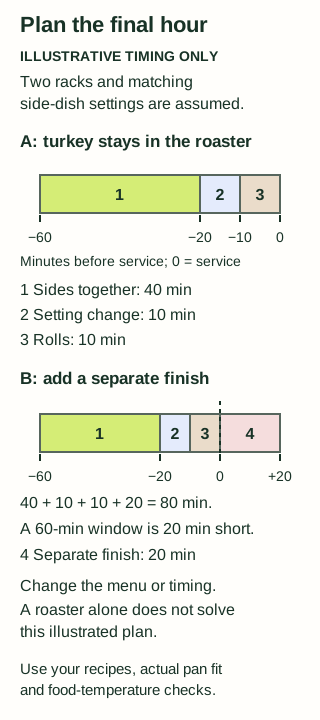
Write down each dish’s recipe temperature, cooking or finishing time, rack space and serving deadline. Identify which steps can share temperature and space. A pan being small enough to go in the oven does not establish that several dishes can cook there together. Use your actual recipes and suitable equipment, not the example timings below.
On small screens, scroll the table sideways.
| Illustrative last-hour task | Assumed conventional-oven time | Assumed rack use |
|---|---|---|
| Two sides at 350°F | 40 minutes together | Both racks; assumed compatible dishes/recipes |
| Setting change | 10 minutes | Planning allowance, not a measured oven response |
| Rolls at 400°F | 10 minutes | Assumed compatible with remaining space |
| Total required slot | 60 minutes | 40 + 10 + 10 |
All cooking temperatures and times in this table are invented menu-planning inputs, not recipes, food-safety endpoints or appliance test results. If a turkey otherwise occupies the main oven until 30 minutes before serving, this example needs 30 minutes more than the 30 minutes available. Moving its complete cooking process to a suitable roaster might free the full 60-minute slot—but only after the turkey, pan and appliance plan are confirmed.
Now add a hypothetical 20-minute turkey finish occupying both racks. The main oven needs 80 minutes, so the same 60-minute window is still 20 minutes short. An electric roaster alone has not solved that menu. Change the recipes, sequence or serving plan rather than assuming a purchase removes the finishing step. We have not established that a particular turkey needs that finish or that it would achieve a particular appearance.
Separate advertised capacity from the food and pan that fit
Hamilton Beach’s US model 32235 product page advertises 22 quarts and up to a 28-pound turkey, with exterior dimensions 14.51 H × 23.15 W × 15.63 D inches. These are manufacturer statements, not a Sift capacity test. Exterior measurements are not internal pan or closed-lid clearance, and an advertised turkey weight does not document every bird’s shape or added vessel.
NESCO’s current MWR18-47 product page advertises 18 quarts and up to a 22-pound turkey. Its linked MWR18 Series manual says most 1- and 2-quart casseroles, 9 × 13 pans and pie plates fit. “Most” is a reason to check your vessel, including handles and lid, rather than a guarantee for everything carrying that size label.
On small screens, scroll the table sideways.
| Fit check | Evidence you need | Do not substitute |
|---|---|---|
| Food/cookwell | Exact food, rack and closed-lid fit under the model’s directions | Turkey pounds or advertised quarts alone |
| Additional vessel | Overall dimensions including handles; approved position inside cookwell | Nominal baking-pan dimensions |
| Operating location | Stable permitted surface, ventilation, exact clearances, power and handling space | Packed or unidentified dimensions |
| Storage | Dry cleaned appliance dimensions and safe storage instructions | Operating space or a product photo |
Use the manual for the precise model label
The current NESCO listing links the MWR18 Series guide. A separate PDF is labelled MWRI18-47, with an additional “I”; that document does not establish the instructions for MWR18-47. Use the manual linked to your exact appliance model. The retrieved Hamilton Beach PDF title identified 32210, and its association with 32235 was not established. An exact 32235 operating recommendation remains open until that model/manual connection is confirmed.
For the documented MWR18 route, the manual requires stable, flat, nonflammable heat-resistant support, ventilation and separation from walls/combustibles. Use its cookwell and lid; the heated base is not the food vessel. Do not move the operating appliance. Follow its exact first-use, preheating and cleaning directions rather than adapting a generic online burn-off routine.
Keep safe cooking independent of the oven-space arithmetic
The federal poultry guidance specifies at least 165°F / 74°C internally, checked in the innermost thigh and wing and the thickest breast. CDC’s turkey guidance explains thermometer checks and safe handling, including avoiding counter thawing and washing raw turkey. This buying worksheet is not an electric-roaster cooking timetable; follow authoritative handling advice and the exact equipment instructions.
If cooked food finishes before service, plan safe holding separately. For a US home buffet, FDA’s buffet guidance says to keep hot food at an internal temperature of at least 140°F and check it with a food thermometer. That holding threshold does not replace poultry’s 165°F cooking endpoint. Use suitable equipment under its exact instructions; a roaster thermostat is not an internal-temperature check.
A roaster’s wattage, a thermostat setting or an old manufacturer roasting chart does not establish this turkey’s completion time, food temperature or energy use. We have not cooked with these products or compared browning, cleanup effort, speed or running cost.
Make the purchase decision from the complete plan
- Reuse the main oven and suitable existing equipment if the real menu already fits. Smaller batches or a different menu may remove the bottleneck.
- Consider a roaster when a verified complete cooking route frees the time/racks you need and its operating/storage space is acceptable.
- Wait if exact manual association, food/pan fit, power or a necessary finishing step remains unresolved. A larger advertised capacity does not close those gaps.
Record the delivered appliance price and any necessary suitable thermometer or accessories once each, with the date and exact SKU. A 12 October listing is not delivery to your address or a completed basket. No current price winner or lifetime saving is established here.
If cooking space is solved but serving temperature is the next problem, use the warming-mat and buffet-warmer purchase checks. Keeping cooked food safely hot is a separate task; a mat does not replace this cooking plan.