English · United States / Buying decision guide
Food-warming mat or buffet warmer? Check your dishes, surface and serving time
A roll-up mat can look easier to store than a buffet tray. The useful buying check is whether your actual dishes, serving time and exact supporting surface permit the setup.
Check the appliance instructions and countertop rules before measuring the dish layout. Geometric fit and surface temperature do not prove safe hot holding: already-cooked hot food needs its internal temperature monitored. If placement or holding remains uncertain, use a different confirmed setup or smaller batches.
Begin with food temperature, not the dial
For a US home buffet, the FDA’s buffet guidance says to keep hot food at an internal temperature of at least 140°F and check it with a food thermometer. A mat’s surface setting measures a different thing. Some warmers do not hold food at that threshold; neither a hot dial nor a warm dish rim proves that the food’s centre is safe.
FDA says to discard perishables left at room temperature for more than two hours, reduced to one hour when the air temperature is above 90°F, unless they have been kept safely hot or cold. Smaller serving batches with suitable hot/cold backup can remove the need for a large spread or another appliance. A holding device is not an assumed way to cook or reheat chilled food.
Make a joint appliance-and-surface check
Read the exact warmer’s allowed surface, ventilation, container and power requirements alongside the exact surface-maker’s heat guidance. “Quartz”, “stone” or “silicone” is not a shared approval. The Caesarstone residential care guide’s heat section distinguishes short exposure from sustained heat and discusses protection under cooking appliances. That does not establish a particular mat/counter combination.
Do not invent a towel, board or trivet workaround when its use could conflict with the appliance’s instructions. The Chefman RJ22-MBTC glass-top tray manual requires a hard, flat, heat-resistant location with eight inches from other objects/liquids, excludes several surfaces and forbids obstructing vents with coverings. Those are this tray’s instructions, not universal mat clearances. A raised tray is also subject to its own placement rules.
The US RJ22-S-GREY product page links the RJ22-S-SERIES user guide. Its warming instructions require a hard, flat, heat-resistant surface and at least eight inches from other objects and liquid sources. They exclude wood/butcher block, recycled material, bamboo and plastic supporting surfaces; quartz is among the listed heat-resistant examples. That list does not settle your exact countertop maker’s restrictions.
Do not cover or wrap this mat with foil, plastic or cloth. Use heat-resistant vessels rather than plastic, and do not move the mat while operating or loaded. The guide permits use for up to 24 hours with supervision; that is not proof of an automatic shutoff or safe food temperature. Its 140/176/212°F settings describe the mat, not the food’s centre. It is not for cooking or defrosting. These are the mat’s own instructions, separately checked on 12 October 2026, rather than transferred tray rules.
Measure overall dishes, including the handles
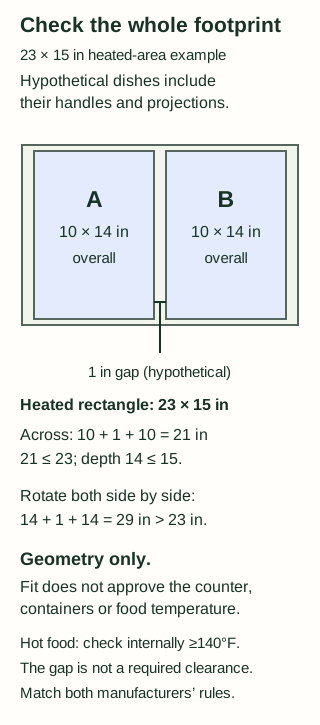
The Chefman Roll n’ Go RJ22-S-GREY product page lists a 23 × 15 inch heated area. Its other dimension entry is not identified as the unrolled working surface, so the heated-area statement is the input used here. On 12 October 2026 the page displayed $79.99 and In stock, ready to ship; that is a dated listing observation, not a delivered quote or confirmation of your setup.
On small screens, scroll the table sideways.
| Hypothetical layout | Required width/depth | Geometric result |
|---|---|---|
| Two 10 × 14 in overall dishes, 10 in sides across; assumed 1 in gap | 10 + 1 + 10 = 21 in wide; 14 in deep | Within the stated 23 × 15 in heated rectangle |
| Rotate both, 14 in sides across | 14 + 1 + 14 = 29 in wide | Exceeds 23 in width |
| Rotated dishes one behind the other | 10 + 1 + 10 = 21 in deep | Exceeds 15 in depth |
The hypothetical 10 × 14 inch measurements include all handles/projections. They are not claimed dimensions of a standard 9 × 13 baking pan. The one-inch gap is an invented planning input, not a clearance instruction. In the first arrangement, centring leaves one inch at each side and half an inch front/back. That arithmetic says nothing about permitted spacing, bottom contact, stability, control-panel clearance or food temperature.
Match the timer to the real service plan
The Good Housekeeping/QVC K84055 usage instructions distinguish surface settings of approximately 130, 160, 185 and 205°F from food temperature. Its troubleshooting section describes standby after three hours of inactivity. This is an exact instruction-file example; current stock and price are not established.
An invented four-hour service exceeds that three-hour inactivity interval by one hour. This exposes a planning question, not an instruction to defeat standby or restart a device indefinitely. Understand the exact timer, supervise and handle food under the applicable directions, and arrange a suitable alternative if the actual holding plan does not work.
Use a purchase checklist with three separate gates
- Placement: both appliance and surface directions allow the complete setup; unresolved restrictions mean wait or choose another confirmed location/device.
- Dish layout: measure each vessel overall and check the documented heated area, approved containers, stability and access. A geometry pass closes only this gate.
- Food/service: suitable already-hot food, thermometer checks, safe hot/cold backup, actual service duration and exact standby/power instructions. An appliance setting cannot close this gate.
On small screens, scroll the table sideways.
| Record for your own setup | Your answer |
|---|---|
| Exact warmer and current manual | Model / manual date or revision / unresolved restrictions |
| Supporting surface | Maker / material / specific heat rule / approved protection if any |
| Vessels | Overall width/depth including handles / base / contents |
| Serving plan | Start/end / standby behaviour / internal-temperature checks / backup |
| Complete purchase | Needed device and extras / tax and delivery / current terms |
This is documentation and footprint arithmetic. No countertop protection, deep-casserole holding, electrical setup, heating uniformity or food-safety performance was tested. Keep existing suitable equipment or serve smaller batches when that meets the need. If the problem is unfinished cooking rather than holding, return to the oven-space planning guide instead of buying a mat to finish it.